If you can’t make it to Pesaro, you can listen here!

Again this year, RAI will be broadcasting the opening nights of the 3 featured operas of the Rossini Opera Festival. On August 8,9, and 10th you can listen to the webcast of “La Donna Del Lago”, “Il Turco in Italia”, and “Ciro in Babylonia”. Curtain is at 8 pm Italian time, so that’s 2 pm, Eastern, etc.
Follow the link and on the Rai Radio 3 website click on “Ascolta in Diretta”
http://www.radio3.rai.it/dl/portaleRadio/concerti/ContentItem-5fcd9d5c-9bc6-4f51-8715-4eaf4e0f3ece.html
Turkish Delight

Il Turco in Italia is NOT a “lesser” L’Italiana in Algeri!
As some who don’t know Rossini might think: “Well, first he sent an Italian girl to Algeria, and that worked so well, so now he’ll try doing it the other way!” NOT SO!
Although “Turco” is less well known, it is on the same artistic level as “L’Italiana” and we wanted to share some thoughts about this opera in anticipation of its appearance at ROF 2016.
As it turns out, we have an excellent guide in the program notes by the legendary Rossini scholar,Phillip Gossett, written for a CD recording of this opera on Phillips. By the way, the Alaimo in this recording is related to the Alaimo who will be singing in Pesaro. Rossini must run in the family.
Gossett starts by debunking the myth that Turco is filled with self-borrowing. “ Corriere delle dame “( Aug 20, 1814) seems to have been the origin of this story.
Then, Gossett declares that Turco is not a poor relative of L’Italiana.
Some of Gossetts points are:
1. L’Italiana is a zany farce with a serious side. Turco, on the other hand is a “comedy of manners” whose themes seem peculiarly modern.
2. If one wants to link “Turco” to another opera, one should look to Mozart’s “Cosi fan tutte” !
There are so many between the two operas, according to Gossett, including the librettist, some of the singers who created the roles, and so forth.
So, those of you who are joining us in Pesaro, think “Mozart” when you hear this opera. Our conductor, Speranza Scappucci, brings her Mozart sensibilities with her, and it is bound to be a memorable experience.
For those who cannot make it, we will post information about the RAI broadcast, both here, on FB and twitter.
New honors for Speranza Scappucci

See the bottom of this post for the great news!
We interviewed conductor Speranza Scappuccci last year shortly after we met her in Washington DC and learned that she will be appearing at the Rossini Opera Festival this summer. Since then she has been busy with performances throughout the world. Her recent performances in US included a much praised “La Sonnambula” which prompted the NYTimes music critic to suggest that it was time for her to “conduct across 65th street at the Met”!
Her most recent US performances were at LA Opera where she revitalized the musical values in the warhorse, La Boehme While at LA Opera, Scappucci was interviewed at length for KUSC and we posted the link to that interview.
In spite of her busy schedule, she has graciously agreed to answer a few more questions for RossiniAmerica, to update her previous interview.
Q. Thank you for again taking time to answer our questions. We are sorry we don’t ( yet) have the technical capability of bringing audio interview here on the site; It is one thing to see your responses “on paper”, quite another to hear you speak with such passion and commitment about your work.
Q. Recently some pages of a Rossini manuscript ( if one can call them that) were posted on FB and they looked like what one commentator called a Rorschach test. They were at least quite frantic and messy. When you study his printed scores do you feel the sense of spontaneity that the listener feels, or is this something that you must “create”?
A. Rossini wrote his operas is very short periods of time ! His genius and creativity are without limit. At the same time I think nothing is left to pure chance with him. To the listener his music of course sounds spontaneous and perfectly balanced, but I am sure that in certain masterpieces although Rossini uses some “formulas” , everything is perfectly planned out and the balance and perfection between word and music is spectacular !
Q. In your comments for the LA Opera interview you mentioned something about “young voices” being ideal for La Boheme. How much does the quality of the voice ( not the technique) matter in a Rossini Opera?
A. What I meant in Puccin’s La Boheme was not young voices necessarily , but youthful characters ! Because it’s an opera about youth,love, life and loss of innocence, sudden death. Because of Puccinis orchestration it is the conductors duty to make sure that the transparency of the heavy orchestration never surpasses the voices. You need healthy voices for Puccini. Same of course for Rossini , for which vocally speaking, it is necessary to have some qualities like coloratura and good legato
Q. We first became aware of your work from the enthusiastic review of your performances of “Il Turco in Italia” at Julliard a number of years ago. You are returning to this work for your Pesaro debut. You frequently say that you start with the score ( to find the “truth behind the notes”, if we recall) what is it like to return to a score that you have already conducted? Is there always something new to discover? How do your previous performances inform the ones you are presently doing?
A. Sudying a score always presents the opportunity to discover new things ! In this edition of Turco in Italia there will be practically no cuts , so some new music for me compared to the Juilliard version . Also I will be dealing with new singers so of course it’s a great opportunity to do things differently !
Q. A well respected American music critic recently bemoaned the quality of the present crop of young American conductors. One of his observations was that they are not mentored, and few, if any, come from a background in opera. Most of the great conductors we can think of did have a background in opera. What role has working with singers have in shaping you as a conductor?
A. For me it was fundamental. Because understanding how the human voice works and coaching singers gives me a more wide spectrum of how music phrasing goes! And it can be applied to phrasing also in the symphonic repertoire . People tend to think that if a conductor comes from opera , they are probably not as great in symphonic repertoire ! I say it’s quite the contrary . If you are able to deal with the stage the singers the chorus etc etc , it is quite likely that working on symphonic repertoire is as good or even “easier” ! Working backstage for years , training singers, next to great conductors can be the best school for a conductor in the making. That is , of course , if there is a basic talent and charisma.
Q. Is there anything you would like to convey to our Festival goers before we all meet in Pesaro?
A. I hope you will all enjoy this Turco in Italia, a real masterpiece of Rossini , often underestimated
Again, thank you for taking the time to answer these questions.
Photo credit : Marco Borrelli
After her Pesaro debut in “Il Turco in Italia”, Speranza Scappucci most recently appeared in Vienna ( conducting Rossini) where she was given this well-deserved, fantastic honor!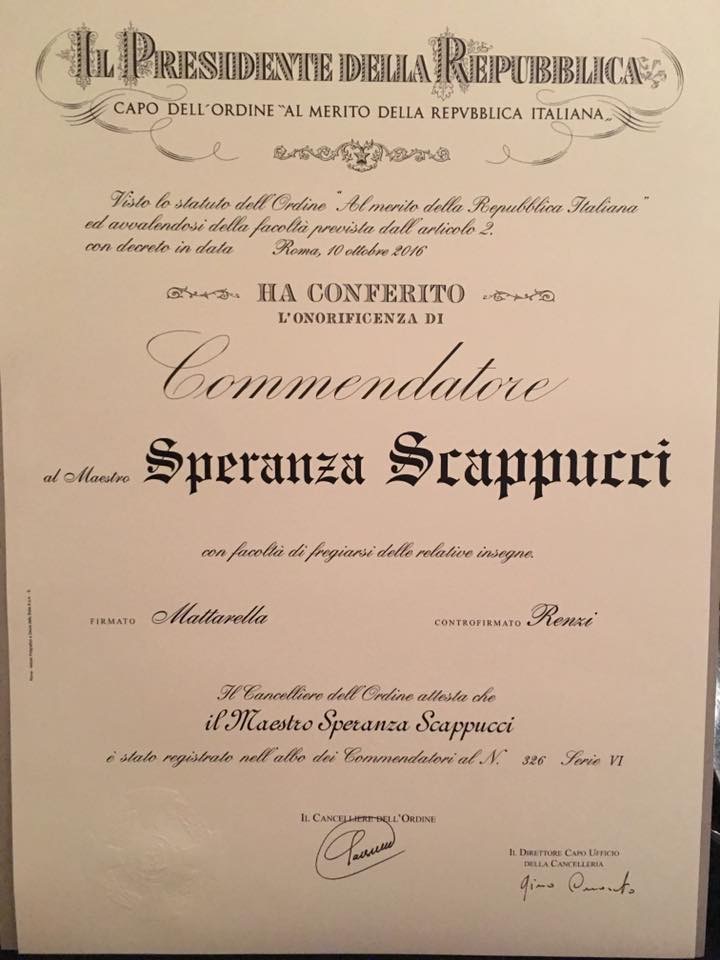
From the May 2016 Newsletter from ROF
FINAL WEEKS FOR THE CONTEST “IL TUO VIAGGIO”
Just three weeks left to join the fourth edition of Il tuo Viaggio, a contest aiming to award a prize to a new talent in the field of graphics by publishing the winner’s work as the front cover of the programme of the opera Il viaggio a Reims at the Rossini Opera Festival 2016.
Up to the 20th June applications can be made online by filling in the relative form. Designs must be submitted in the jpg format, cmyk mode, low resolution. Participants in the competition may submit more than one design. The winner will receive two free tickets for the opera.
THE RETURN OF CIRO IN BABILONIA
The revival of Ciro in Babilonia, first heard in the successful revival of 2012, will be the occasion for the return to Pesaro of Ewa Podles, the charismatic contralto around whom Davide Livermore had arranged his staging. The irreplaceable protagonist will be supported by such artists worthy of her as Pretty Yende and Antonino Siragusa. The Chorus and Orchestra of the Teatro Comunale, Bologna will be conducted by Jader Bignamini, one of the leading and most interesting conductors of the younger generation.
The production of Ciro in Babilonia, which was based upon the spectacle typical of silent films, was unanimously praised four years ago, and won the Abbiati prize for Gianluca Falaschi’s costumes.
Rene Barbera is returning to ROF this summer!
After a triumphant debut in last summer’s Festival ( his performance in Stabat Mater was particularly moving) Rene will be returning to ROF to star in “Il Turco in Italia” under the baton on Speranza Scappucci, and in a new production by Davide Livermore.
Be sure to read our interview with Rene, made before his ROF debut.
Wise words from our conductor making her ROF debut this summer!
This clip is about half and hour long. The interview is related to her appearance at LA Opera in Puccini, but much of what she says about preparation applies to Rossini as well.
Hope it works! Enjoy!
Rossini here, Rossini there
From Houston to the Bronx, small opera companies are presenting Rossini this month!
The Bronx Opera, which celebrates its 49th birthday, has two more performances of “Cenerentola” May 7 and 8th. Looks like a great opportunity to introduce young people to opera. More information at www.bronxopera.org.
Then there is Operativo Houston, which is presenting “La cambiale di matrimonio” on May 14th. For more information see www.operativohouston.com
The artists and everyone involved are clearly doing this because they love Rossini. We wish them good luck and full houses!
Remembering a joyous moment at ROF
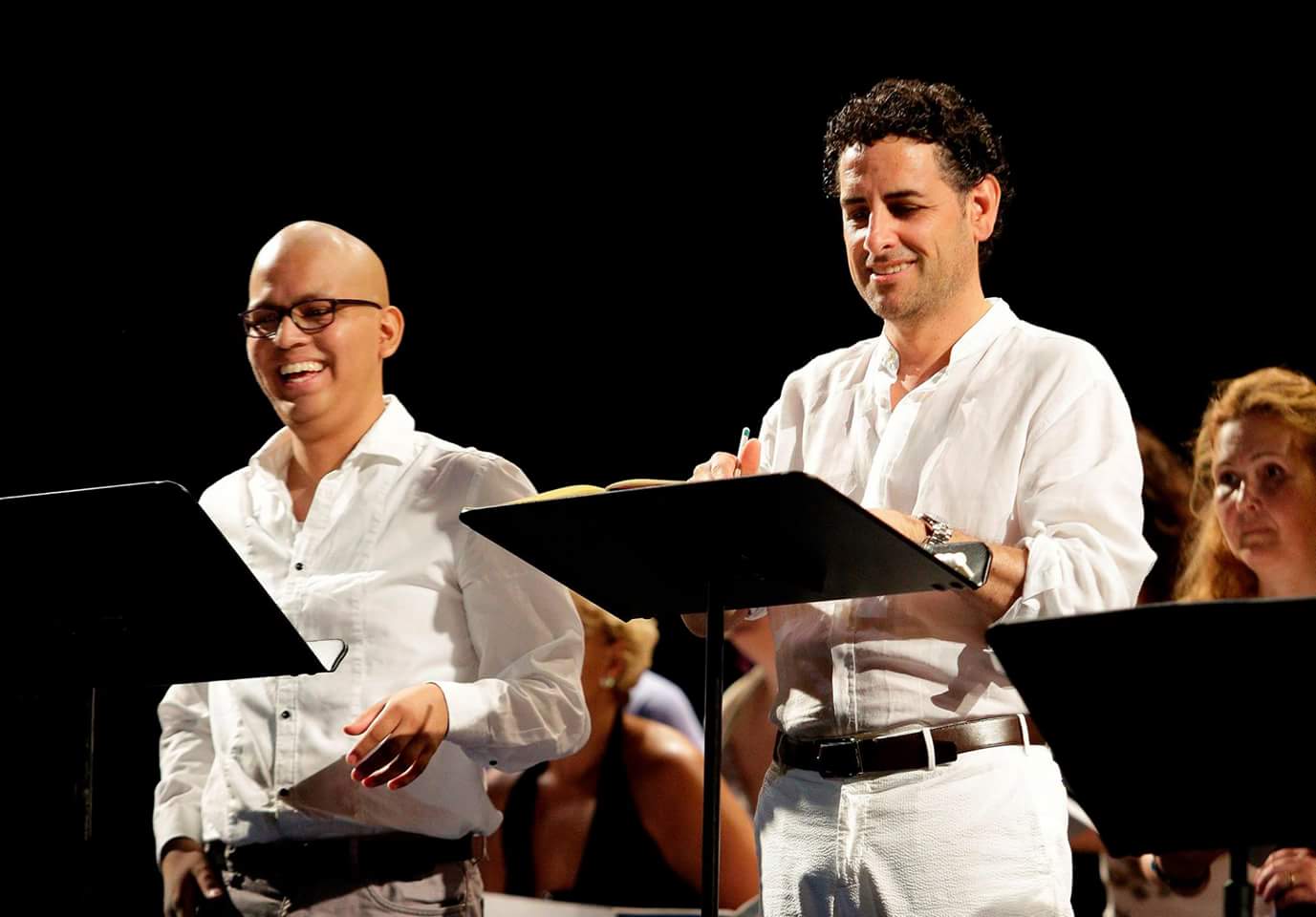
The news of the loss of Dempsey Rivera spread throughout social media recently. A much-loved young talent who first appeared at the Rossini Opera Festival as a member of the Accademia Rossiniana, Dempsey returned to appear in Aureliano in Palmyira the following year. Last summer he appeared in Messa di Gloria ( seen here with Juan Diego Florez). Most likely many in the audience didn’t know of Dempsey’s illness and treatment; his bravery and determination in sharing his talent now seems bitter-sweet. Thanks to ROF for providing this beautiful photograph. And condolences to Dempsey’s friends,colleagues,and family.
Extending the heritage of Alberto Zedda in Canada
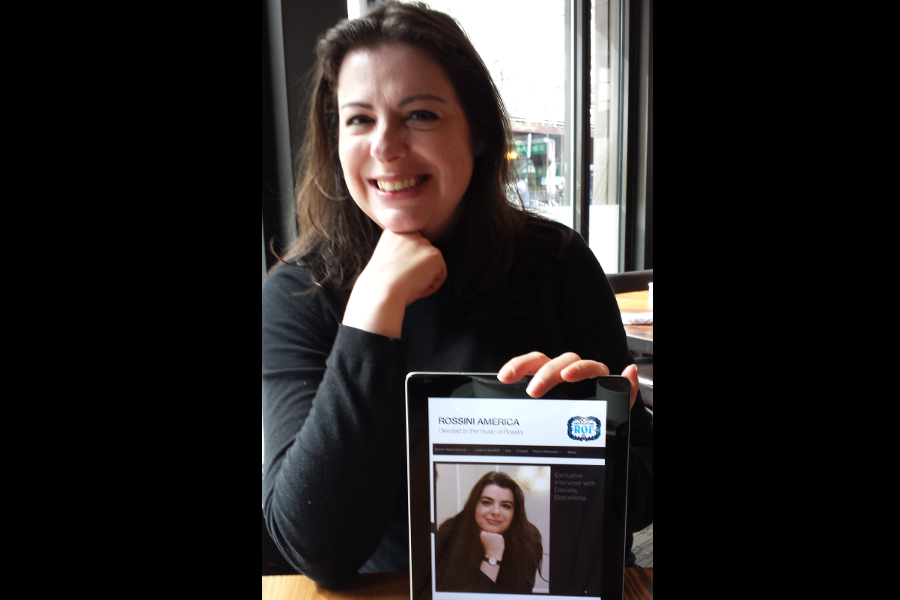
Fresh from a triumphant concert at La Scala, Daniela Barcellona accompanied by her husband, Alesandro Vitiello, arrived in Lunenburg,Canada,to continue the work begun by the late Alberto Zedda at the Rossini Opera Academy.
Zedda had hoped that the enterprise started by him and others 4 years ago would flourish and spread throughout North America.
Lunenburg is fortunate to have Daniela, herself a graduate of the Accademia Rossiniana in Pesaro, Italy, maintain Zedda’s knowledge,passion, and dedication to guiding the next generation of Rossini singers.
Read our interview with Daniela elsewhere on this site.
In grateful memory: Sir Peter Moores
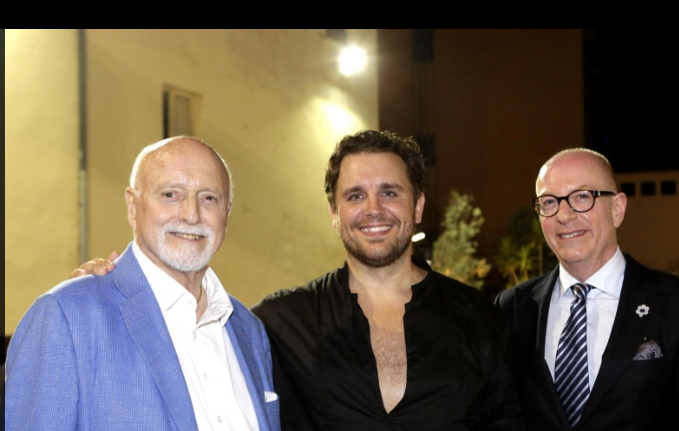
Some may not know the name Sir Peter Moores. But anyone who loves bel canto opera, and Rossini in particular owes him a debt of gratitude. Sir Peter through his foundation helped establish ( and continued to support) Opera Rara which has brought works that were less well known to a broad audience.
The support of the Sir Peter Moores Foundation for the Rossini Opera Festival, in particular the Accademia Rossiniana has been so critical in grooming the next generation of Rossini singers.
In addition to the financial support, Sir Peter clearly loved being in Pesaro for the Festival where many “ordinary” Festival goers had a chance to meet him.
In the picture Sir Peter is pictured at a dinner following “Aureliano in Palmyra” at the Rossini Opera Festival in 2014. He is pictured with Michael Spyres ( who sang Aureliano and will be appearing again at ROF2016) and Gary Gordon from the board of the Friends of the Rossini Opera Festival. The picture taken by Luigi Diolvei appeared in the on-line IlRestodeCarolino.it.
Michael Spyres mentioned on that occasion that Opera Rara had played an important part in his pursuing the repertory that he now excels at. A wonderful memory.
Sir Peter wrote an introduction to the book ” Accademia Rossiniana XXV, una storia” which was published by ROF in 2013 in which he makes the case for the ROF in general and the Accademia in particular. It appears in Italian in the book, but below is the original English from which it was translate
May 2013
Opera Festival – Pesaro
Most of those reading this programme won’t remember the operatic repertoire of the middle fifties. Do you know how many of Rossini’s operas you could see? One! Il Barbiere or perhaps two? L’Italiana in Algeri. Rossini had led a fashion in Paris for Grand Opera, which naturally were Opere Serie and this fashion produced voices and grew from Lirico Leggiero, to Lirico, to Lirico Spinto and on to Dramatisch and Hoch Dramatisch leading bel canto into CAN BELTO. Rosina had to sing Amneris. This in turn led to larger and larger houses and heavier repertoire.
The establishment of speciality Summer Festivals in the last century saw the founding of Pesaro’s Festival and (not forgetting Bayreuth) others of which Pesaro had the most radical result. Pesaro revived operas by Rossini unheard for years. These almost always involved revision in length and depth of the score(s) – and sometimes there were a variety of scores. Rossini himself had often been present for these revisions – revivifications – and lengthened or shortened the score, rewriting or replacing arias and duets for the second performances. What scores remain to us are not always in Rossini’s own hand, so questions of editorship arise, especially as the revification in question may not have brought a successful revival and so could peter out after one or two performances, leaving the world without a final approved author’s score.
Rossini Opera Festival under the leadership of Gianfranco Mariotti and Alberto Zedda has proved itself well able to cope with the adventurous path they had chosen, building not only a larger and larger Rossini repertoire there, but also first refining a musical and vocal style, which would sustain this, and training and raising musicians – not just singers – in such style as to act as a model and example to other careful musical festivals and then to repertoire Houses seeking to extend their annual repertory chosen from three Verdis, three Puccinis, Carmen, Faust and Don Giovanni.
Pesaro has also kept where it is not only by judging its music and its behaviour with a self-critical eye, but making sure to keep itself in funds – nowadays a very important part of running an Opera House. The thoughtful relaxed and friendly atmosphere of the staff, the artists, and the town itself have made us all want not only to be regular visitors each year, but to put as much help and financial support into helping Pesaro as we can each possibly manage.